
That musty smell in the hallway closet often starts below your floors. Crawl spaces in Prince Frederick, MD, pick up moisture from humid Chesapeake summers, heavy storms, and soil that holds water long after the rain stops. Damp air under a house feeds mold, softens the wood framing, and attracts pests.
A crawlspace dehumidifier can solve the air-side of that problem, as long as the space around it is set up right. Below, you’ll learn how to check your own crawl space and how crawl space humidity control works. We’ll also cover what separates a good unit from a bad one and where a dehumidifier fits with crawl space encapsulation and other moisture control steps.
You can learn a lot before calling anyone. Pick up an inexpensive digital hygrometer at the hardware store and place it as far into your crawl space as you can safely reach. Readings right by the access door pick up outside air and won’t tell you much. Leave it for a few days and then check back. Midsummer gives you the most honest picture.
Budget hygrometers can be off by a few percentage points, so watch the trend over several days rather than trusting a single reading. As a general guide:
Next, grab a flashlight and take a look around. Watch for exposed wiring, sharp debris, and critters. If anything feels unsafe, stay out and call for an inspection.
Can’t get in, or you’d rather not? Our free inspection covers it.
Many homes, especially older ones, have vented crawl spaces. In summer, warm, humid air drifts in through those vents and hits cooler surfaces like ductwork, pipes, and the underside of your floor. Then it condenses, the same way a glass of iced tea sweats on the porch in July. Builders added those vents to dry the space out, but in a humid climate, they often let in more moisture than they release.
The ground adds its share. Bare soil gives off water vapor continuously. After a big storm, runoff and groundwater can collect under the house, especially where grading or downspouts point water toward the foundation.
Most building-science guidance recommends keeping crawl space air below 60% relative humidity, and many contractors aim for about 50%. Wood is where the damage adds up. Joists, sill plates, and subfloor sheathing absorb moisture from the surrounding air. Framing that stays above about 20% moisture content is at risk for fungal growth and decay. Dry framing usually reads well below that on a moisture meter. Badly damaged wood may need subfloor and joist repair.
Bouncy or uneven floors don’t always trace back to moisture, though. Failed supports, sunken footings, and undersized framing can cause them, too. It’s worth pinning down the real cause before deciding on floor support or sagging floor repairs.
The unit pulls in damp air and passes it over a cold coil, where moisture condenses and drains away. Drier air then blows back into the space, and a built-in humidistat cycles the unit on and off to hold your target.
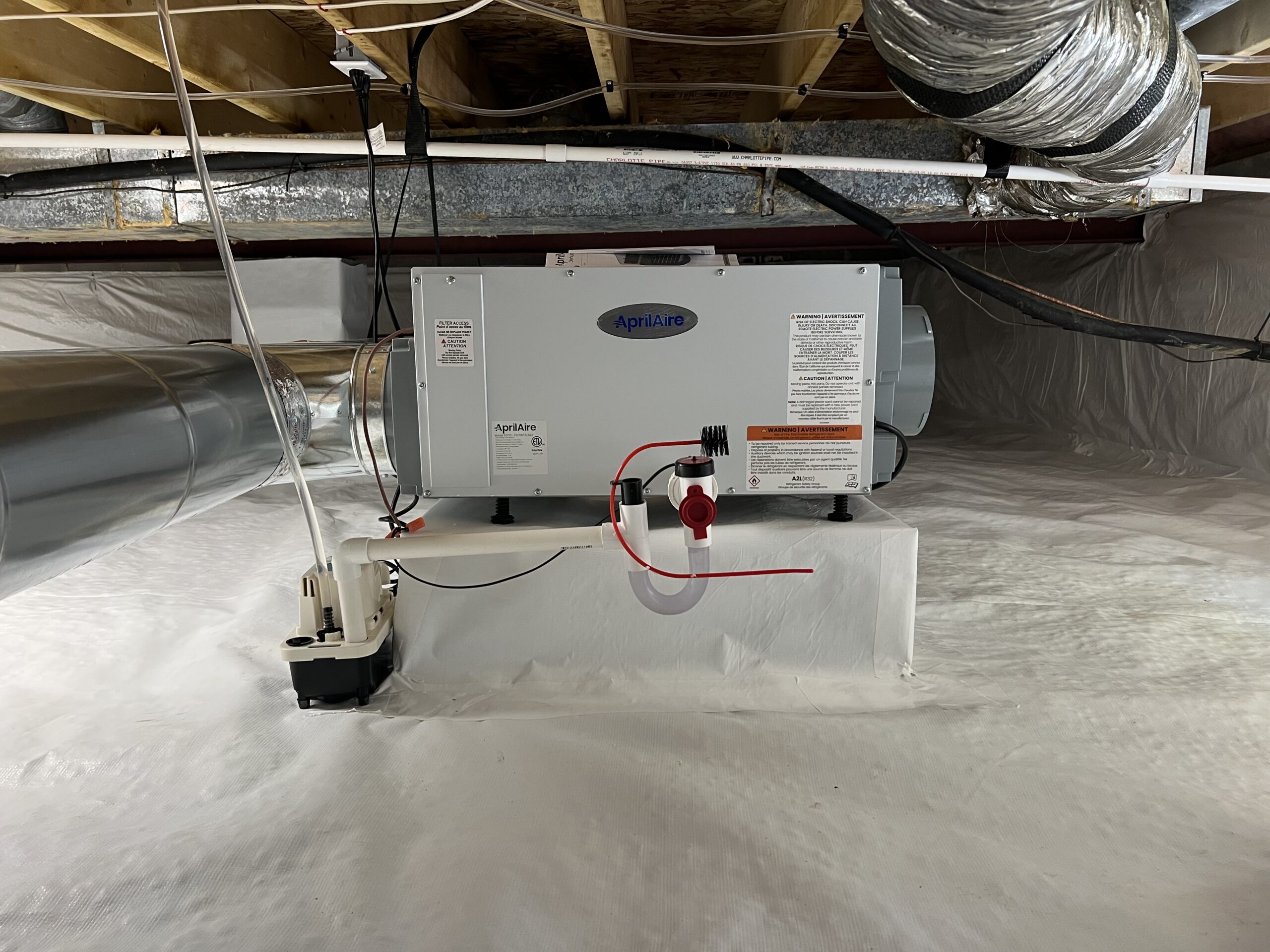
Crawl space models are built for the job. They run for months at a time, work in cooler temperatures, drain automatically, and fit in low-clearance spaces. A portable unit with a bucket isn’t designed for those conditions and often struggles to keep up.
A dehumidifier in a vented crawl space is basically trying to dry out the whole neighborhood. Humid air keeps pouring in, so the unit runs nonstop while the humidity barely moves.
When the situation calls for it, we pair a dehumidifier with crawl space encapsulation. A heavy-duty vapor barrier covers the soil and runs up the walls, and we seal the vents and other openings. We use Viper reinforced barriers in 12-mil and 16-mil thicknesses. They’re woven, U.S.-made, and puncture- and tear-resistant. With the space sealed, the dehumidifier only has to manage a small, controlled volume of air.
The International Residential Code, the model code most U.S. jurisdictions build from, allows sealed crawl spaces when the ground is covered and the air is conditioned. Recent editions list a properly sized dehumidifier as one accepted option. Local adoption and permit rules vary, so check with Calvert County before any work begins.
The dehumidifiers we install are AprilAire units, and they work in basements and crawl spaces.
You can ballpark this yourself:
As a hypothetical example, a 600-watt unit running eight hours a day would use 4.8 kWh. Multiply that by the rate on your electric bill. Run hours climb in humid summer months and drop in drier seasons. A sealed crawl space keeps them much lower than a vented one.
Pint ratings come from lab test conditions, so real performance under your house will vary. For sealed crawl spaces, recent editions of the model code use 70 pints per day for every 1,000 square feet of floor area as a benchmark.
Good sizing also accounts for:
An undersized unit may run constantly and still fall behind. Oversizing costs more up front than it should.
Dehumidifiers handle humidity. Standing water calls for different tools. A complete waterproofing service works in layers:
Solid crawl space waterproofing gets every layer working together, which is why the dehumidifier usually goes in last.
Clean or replace the filter on the manufacturer’s schedule, and keep the drain line clear. Our crawl space maintenance visits check for worn parts, loose barrier seams, and rising moisture before small issues get expensive.
Homeowners in Prince Frederick, MD, can schedule a free crawl space inspection with our team. Our crew checks for moisture, damaged insulation, failed pumps, organic growth, and the condition of any existing barrier. We usually take photos so you can see what’s going on down there without having to crawl in yourself. After walking you through your options, we leave the estimate with you so you can take your time deciding.

28799 Three Notch Rd, Mechanicsville, MD 20659
Mon - Sun: 7am - 5pm