
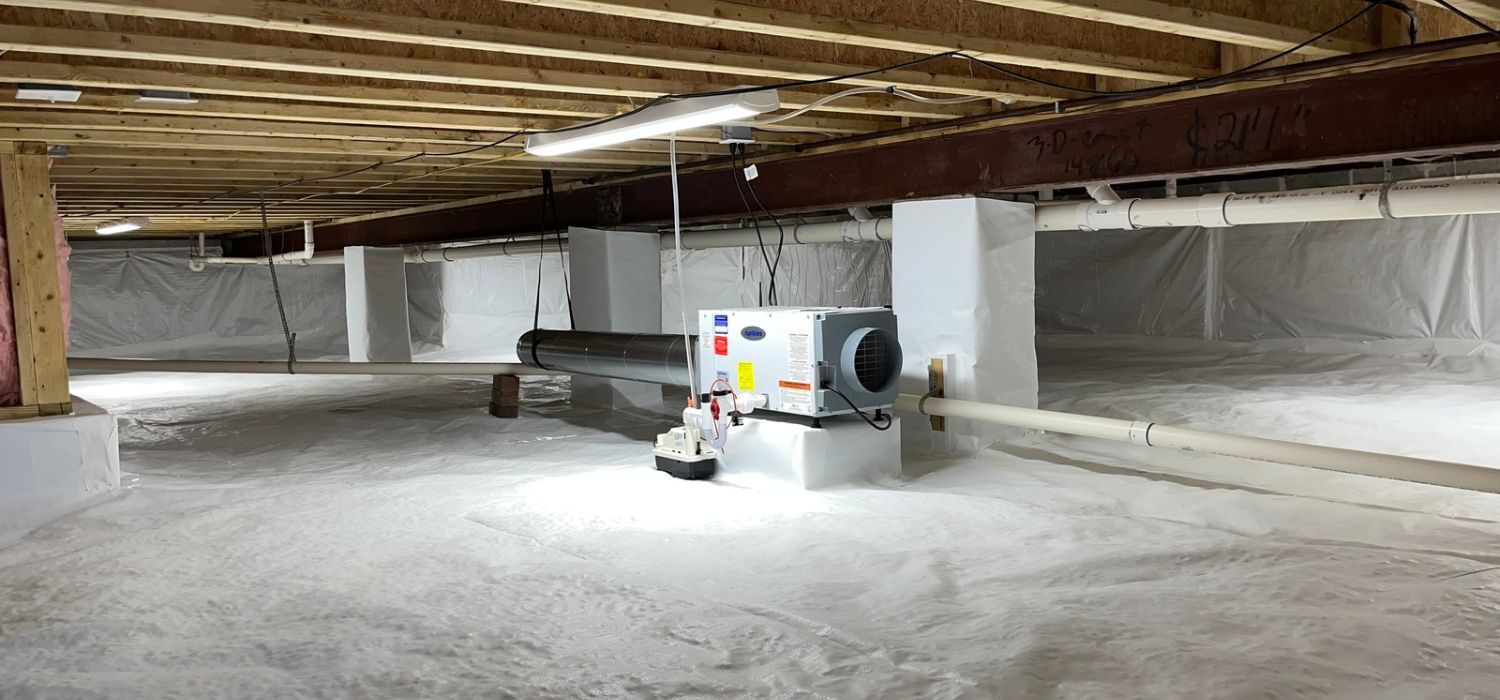
Own a home, a rental, or a small commercial building in or around Lexington Park, MD? If it sits over a crawl space, that’s a likely spot for moisture trouble. Crawl spaces are out of sight, so nobody thinks about them until a musty smell won’t go away.
We’re Brincefield Crawlspace Solutions, a local crew based in Mechanicsville, and we spend our days in crawl spaces throughout Southern Maryland. Before you call any commercial waterproofing service, this guide walks you through why crawl spaces here stay damp, how to check yours, and which fix fits which problem.
Lexington Park sits near where the Patuxent River meets the Chesapeake Bay, so summers are muggy. That humidity drives many local crawl space problems.
Warm, wet summer air drifts in through the foundation vents. When that air comes into contact with surfaces colder than its dew point, such as ductwork or floor joists, moisture condenses directly on them.
That’s why the old advice to “keep the vents open so it dries out” often backfires in our climate. A North Carolina building science firm, Advanced Energy, put this to the test in a field study. Summers there are humid like ours. Sealed crawl spaces stayed under 60% relative humidity all summer, while vented ones tracked the muggy outdoor air.
Other sources pile on. Bare soil gives off moisture around the clock. Short downspouts and poor grading direct rainwater toward the foundation. After a long, soaking storm, groundwater can push up from below.
Grab a cheap digital hygrometer. Think of it as a weather station for the underside of your building. If you can do it safely, set it a few feet inside the crawl space access. Readings right at the opening pick up outside air. Leave it for a few days in the summer. If it keeps showing more than 60%, you’ve got a moisture problem worth fixing.
Shine a flashlight around from the access door. Look for:
Pay attention upstairs, too. A musty smell on the first floor, bouncy floors, and hardwood that’s starting to cup can all point to moisture below.
A quick safety note: don’t crawl in if there’s standing water near wiring, signs of animals, or heavy visible mold. Take a photo from the doorway and leave the crawling to us.
Here’s a quick cheat sheet:
If water pools in your crawl space after a storm, sealing it up just traps that water inside. Drainage has to be part of the plan before anyone seals the space.
Full crawl space encapsulation is our bread and butter. The job lines the ground and walls with a heavy barrier, seals the vents and other openings, and controls the humidity, adding a dehumidifier when moisture conditions call for it. A sealed crawl space still needs a way to dry out. Depending on the building, a full job can also include insulation removal and replacement, foam board on the walls, and a sump pump. Most projects wrap up in a few days.
Vapor barriers cover the ground to block moisture rising from the soil. They’re a good fit for a crawl space that’s fairly dry and mostly needs protection from ground moisture. Just know a ground barrier won’t stop muggy air coming through open vents. If humidity is the main problem, encapsulation is usually the better fix.
Our go-to is Viper reinforced poly, made in the U.S. by ISI Building Products. We can install it in 12 mil, with a thicker 16 mil option. The woven material has protective layers on both sides, resists punctures and tears, and doesn’t off-gas. It also carries a lifetime warranty.
Any good drainage contractor starts by figuring out where the water’s coming from. Our drainage solutions include downspout extensions, trenching, yard drainage fixes, and interior or exterior French drains built with 4-inch corrugated pipe set in gravel.
When water needs to be pumped out, sump pumps handle it. Zoeller is our go-to brand because it’s American-made. Its M53 carries a three-year warranty, and the M63 steps up to a cast-iron base and impeller with a five-year warranty. Drummond pumps are another option we install, along with battery backups for storms that knock out the power.
When water’s already gotten in, water mitigation comes first. That’s where sump pumps, drainage fixes, and the removal of soaked insulation come in.
Can you dry out wet fiberglass insulation and reuse it? Our approach is to replace it, since soaked fiberglass sags, holds moisture against the wood, and loses much of its insulating value. Owens Corning batts go back in, usually R-19, with R-13 or R-30 depending on the space.
For ongoing commercial moisture control, AprilAire dehumidifiers are our pick for crawl spaces, basements, and attics.
Pumps wear out, dehumidifier filters clog, and barriers can pull loose. Regular crawl space maintenance keeps a good system working, and a quick look after any major storm is smart. Between visits, clean or replace your dehumidifier’s filter as recommended by the manufacturer.
During a free inspection, we check for moisture, damaged insulation, failed pumps, and organic growth. Sometimes the fix is small, like replacing a pump or dehumidifier, rehanging insulation, or re-securing a vapor barrier that’s come loose.
Your floor joists and subfloor sit right over the crawl space. When they stay damp, wood softens and rots, and floors start to sag. Solid foundation moisture protection keeps that framing dry and costs far less than structural repairs down the road.
Air quality matters, too. Air from the crawl space moves up into the living or working space above it, so a moldy crawl space means musty air upstairs. Good property waterproofing protects the building and the people inside it.
Before you hire anyone for crawl space waterproofing, ask these:
Steer clear of anyone who uses scare tactics or pushes you to sign on the spot.
We’re small, owner-operated, and based on Three Notch Road in Mechanicsville. Jim Brincefield started working under houses in North Carolina in 2015, on weekends and during summers while in college. He enjoyed the before-and-after aspect of the work and the feeling of making a difference. In 2023, with his Maryland home improvement license in hand, he opened Brincefield Crawlspace Solutions
Most of our work is in homes, but the same crawl space and drainage fixes often work for smaller commercial buildings. Reach out, and we’ll tell you honestly whether your property is a good fit.
Free inspections and estimates are available in St. Mary’s County, and emergency service is there when you need a fast turnaround. Military members and first responders get 10% off as our thank-you for their service, including the many service members stationed at Naval Air Station Patuxent River. We’re licensed, insured, and open seven days a week from 7 a.m. to 5 p.m.
Got a musty smell or a reading over 60%? Your crawl space is trying to tell you something. Request a free estimate online, and we’ll come take a look.

28799 Three Notch Rd, Mechanicsville, MD 20659
Mon - Sun: 7am - 5pm